
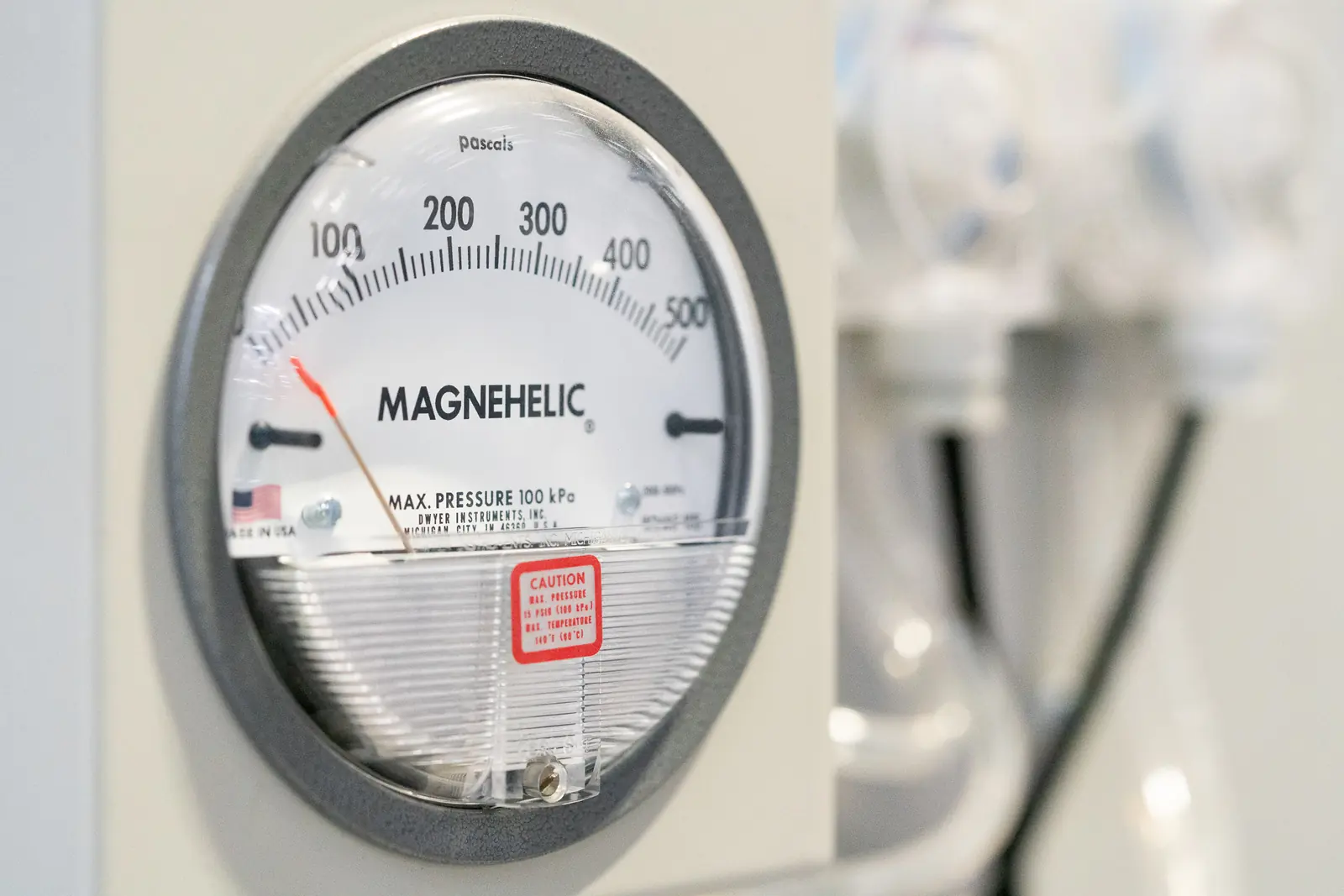
Humidity is relative — and that's the trap
Relative humidity is a function of temperature. The same moisture content reads as a different RH at 15°C than it does at 20°C. That is why the classic failure mode is not a broken humidifier — it is a wide operating band with rapid temperature swings, where the RH chases the thermometer up and down and never settles inside the specification.
Chase the humidity and you will lose. Hold the temperature, and the humidity becomes something you can control.
What's actually at stake
Chocolate degrades quickly when the temperature varies. Pharmaceuticals that get too warm don't get a second chance — they are scrapped. Fine wine spoils or evaporates if the corks aren't held at a specific humidity. And people slow down fast when they are too hot or too cold. These are not hypotheticals; they are real situations we have encountered and engineered our way through.
Our systems protect hundreds of millions of pounds of inventory in warehouses throughout the UK and Ireland. When the stock is worth that much, the environment holding it is not a utility — it is the last line of defence.
A matrix of sensors, not a single set-point
Humidity control is usually product-storage-led: it is added to a full temperature-control system, not bolted on instead of one. We measure across the space with a matrix of sensors, then condition the air using chill and reheat or dedicated dehumidifiers and humidifiers, holding exceptionally high tolerances. Precision control runs to ±0.25°C where the specification calls for it, with advanced controls coordinating every zone.
One sensor tells you what the air is doing next to the sensor. A matrix tells you what it is doing next to the product.
Proven where it counts
We have delivered humidity-critical installations for confectionery storage and production and pharmaceutical facilities — sectors where the specification is the business. At a Derby confectionery storage and co-packing facility, we run four independently governed zones — temperature, humidity and biosecurity pressure — under one roof, with seven Balanced JET systems and a central chilled-water plant. Read the case study.
And because the specification is only as good as the evidence behind it, we design to an agreed performance envelope with backup matched to criticality — the approach behind our compliance and temperature guarantee.
Our approach
Product and specification review — what the product actually needs, the band it must hold, and what happens commercially when it doesn't
Temperature stability first — RH is relative to temperature, so uniform, stable temperature control is the foundation everything else stands on
Sensor matrix design — a matrix of sensors across the space, because a single set-point in one corner tells you nothing about the far racking
Conditioning method selection — chill and reheat, or dedicated dehumidifiers and humidifiers, chosen for the tolerance the product demands
Verification and ongoing monitoring — remote monitoring with automated compliance reporting, so the evidence exists without feet on the ground
Why Jet Environmental
- Temperature uniformity within ±1.0°C across the entire facility — the stable base that makes tight humidity control possible
- Precision control to ±0.25°C where the specification demands it, with BMS integration and multi-zone coordination
- A matrix of sensors holding exceptionally high tolerances, not one probe by the door
- Additional capacity or backup matched to the criticality of your system and your stock
- Humidity-critical installations delivered across the UK and Ireland