
The problem with conventional HVAC
In a conventional system, warm air rises and stays there. The temperature gradient in a typical warehouse runs 0.5 to 1.0 degrees per metre of height. In a building with 10 metres of headroom, the air at the ceiling can be 10 degrees warmer than at floor level. You are paying to heat air that sits above your occupied zone doing nothing.
De-stratification fans help, but they are a sticking plaster. They push warm air down, it rises again, and the cycle repeats. The underlying physics hasn't changed — you have just added moving parts and electricity to manage the symptom.
How Balanced JET Technology works
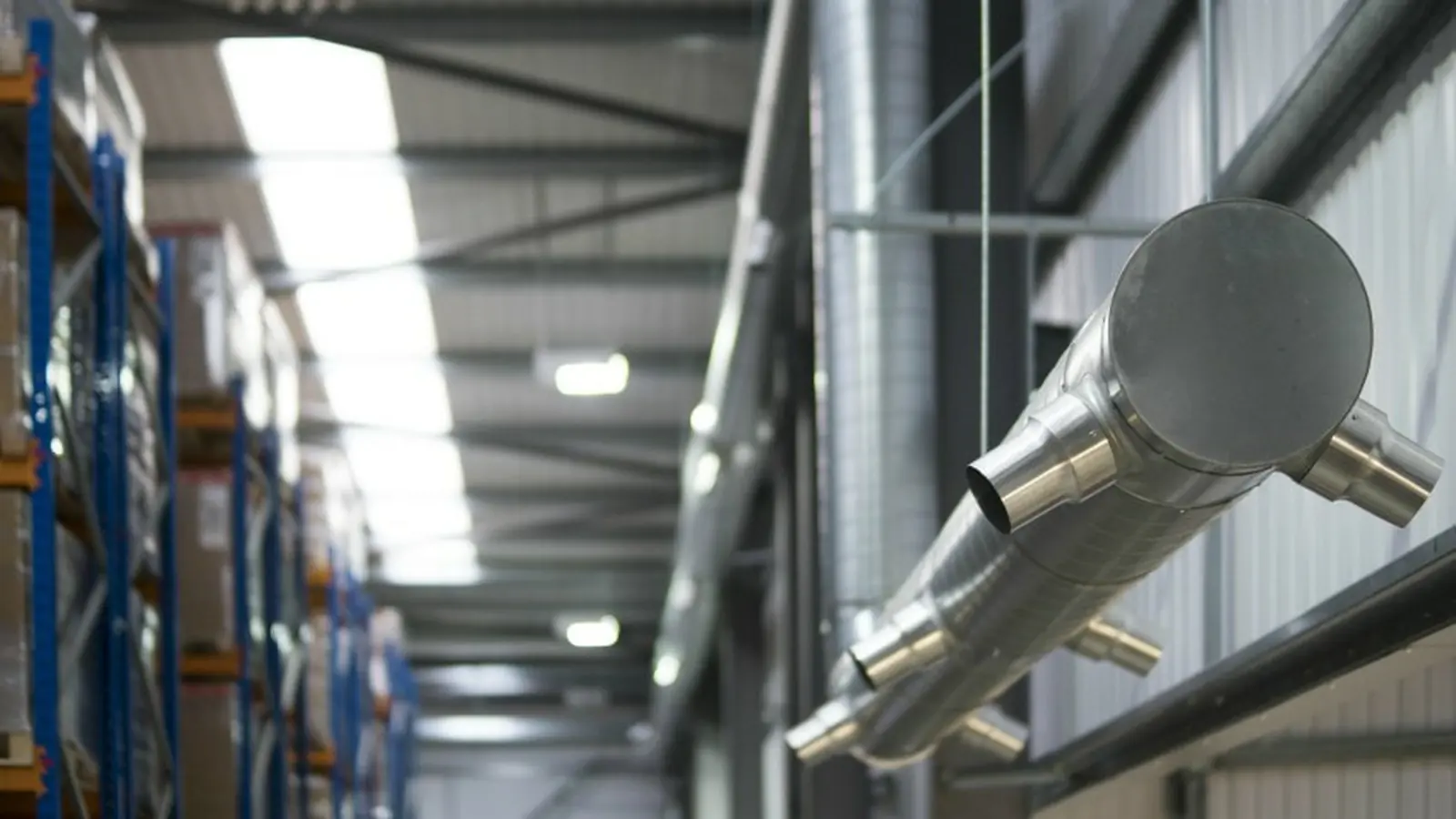
Conditioned air travels through spiral wound or fabric ductwork fitted with precision nozzles. Each nozzle is computer-calculated before installation — sized, spaced and angled for your specific building geometry. There is nothing to adjust on site. No control dampers. No balancing valves.
When conditioned air exits a nozzle at high velocity, it creates a pressure difference with the surrounding room air. The jet draws slower-moving air into the conditioned stream, inducing circulation throughout the space. The system doesn't just push air into a room — it recruits the room air to do the work.
The result: temperature within ±1.0°C throughout the complete space. Horizontally and vertically. The air at 12 metres is effectively the same temperature as at 1 metre. No conventional system can match that.
Nothing at high level to maintain
There are no dampers, motors or actuators in the ductwork. Nothing that moves, nothing that wears, nothing that needs a cherry picker and a maintenance contract. In most installations, high-level access is eliminated entirely. That means safer operation, lower ongoing costs, and a system that performs the same in year ten as it did on day one.
Where it works
- Warehousing and logisticslarge-volume spaces where conventional systems waste energy heating air above the occupied zone
- Pharmaceutical facilitiesGMP-compliant environments requiring close-tolerance temperature and humidity control
- Food production and cold storageHACCP-compliant facilities where even a small temperature inconsistency compromises product quality
- Manufacturing and productionprocess environments where temperature affects material properties, curing times, or product tolerances
- Museums and archivesconservation-grade climate control for collections that cannot be replaced
- Aircraft hangars and large-span buildingsspaces where traditional distribution methods simply cannot achieve adequate throw
The energy case
When warm air is not collecting at your ceiling, you are not paying to heat it. In tall buildings, eliminating stratification losses alone can cut heating energy consumption substantially. That saving starts on day one and compounds every year the system runs.
The induction effect also means each nozzle moves more total air than it delivers — the system leverages room air to distribute the conditioned supply. Smaller air handling units, lower fan energy, reduced ductwork sizes. The equipment shrinks because the physics is doing the heavy lifting.
Our approach
Site survey — we measure your building, your heat loads, your operational reality. Not a desktop exercise.
Computational nozzle design — every nozzle size, spacing and angle calculated for your specific geometry. The balance is engineered before anything is built.
Equipment specification — air handling units, heat sources and controls sized to match the distribution design, not the other way around.
In-house fabrication — ductwork and nozzles manufactured to the design specification in our own facility.
Installation and verification — system installed, performance tested against design parameters. We don't leave until the numbers are right.
Why Jet Environmental
- Temperature uniformity within ±1.0°C throughout the complete space — floor to ceiling, wall to wall
- No moving parts in the distribution system — nothing at high level that ever needs maintaining
- Designed once, balanced forever — no commissioning adjustments, no seasonal rebalancing
- Lower energy bills from day one — you stop paying to heat air that sits above your people
- Proven across 700+ projects in warehousing, pharmaceutical, food production and manufacturing